
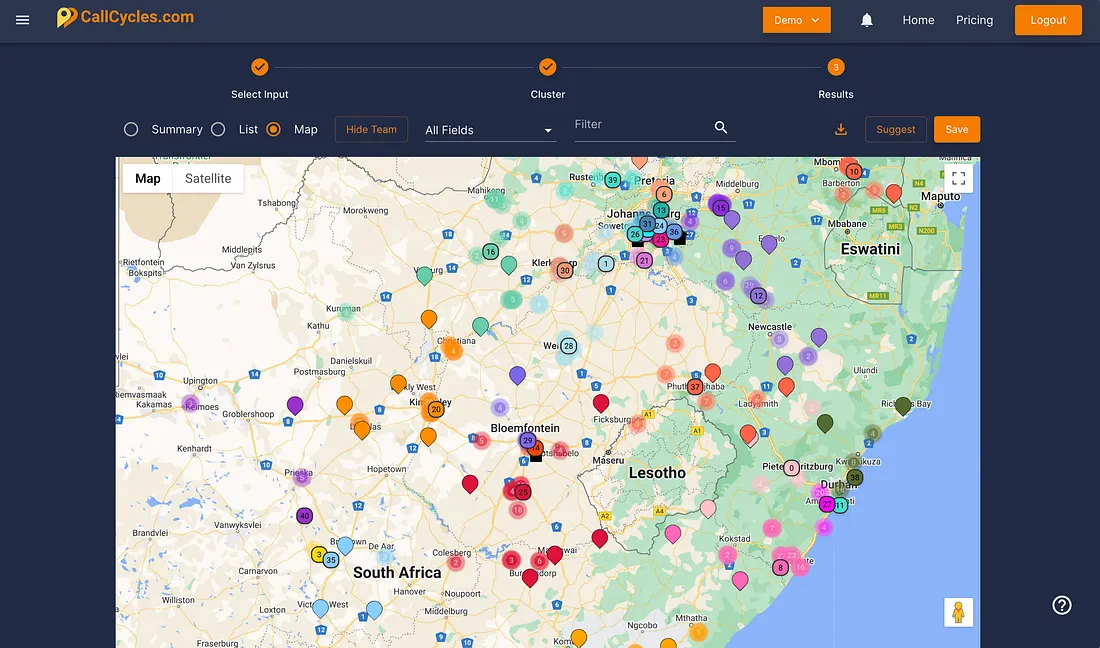
In the realm of call cycles and your sales team, route optimization plays a pivotal role in enhancing efficiency, reducing costs, and improving overall service quality. However, before diving into the intricacies of route planning algorithms, it is essential to recognize the value of geographically clustering customers. Let's explore why this step is crucial at www.callcycles.com and how it impacts route optimization.
Understanding Customer Clusters
Geographical clustering involves grouping customers based on their proximity to one another. Rather than treating each customer as an isolated point, clustering allows us to identify patterns and similarities. Here's why it matters:
Cross-Pollination of Customers
Customers in a geographic area often get assigned to different sales reps over time, leading to inefficiency as two reps may visit the same region.
This happens because customers are viewed as data points in an ERP system rather than being mapped geographically, causing overlap and missed opportunities for streamlined service.
The result is increased wind screen time and less time visiting and selling to your customer base.
Benefits of Geographical Clustering
Reduced Travel Distance
When customers are clustered, the total travel distance decreases. Delivery trucks or service vehicles can efficiently cover multiple stops within a smaller radius. This reduction in distance directly translates to cost savings (fuel, maintenance, and time).
Improved Time Management
Efficient clustering allows for better time management. Drivers spend less time navigating between distant points and more time serving customers. Timely deliveries enhance customer satisfaction and loyalty.
Enhanced Resource Allocation
Clustering enables smarter resource allocation. For instance:
- A single sales person can handle multiple calls in a neighborhood.
- Distributing promotional materials becomes more effective when targeting specific clusters.
Urban vs. Rural Considerations
Urban Areas
Urban environments exhibit dense customer clusters. Here's why clustering matters in cities:
- Traffic Congestion: Urban traffic can be chaotic. Clustering minimizes the impact of congestion by grouping nearby stops to one cluster.
- Shared Infrastructure: Urban customers often share common infrastructure (e.g., shopping centres, office buildings). Efficiently serving these clusters optimizes resource utilization.
Rural Areas
Rural regions have dispersed populations, but clustering remains relevant:
- Community Hubs: Even in rural settings, certain hubs (e.g., town centers) attract customers. Clustering around these hubs simplifies the call cycle.
- Delivery Routes: Rural delivery routes benefit from clustering to avoid unnecessary detours.
Challenges and Considerations
Dynamic Clusters
Remember that clusters evolve over time. New businesses open, demographics change, and traffic patterns shift. Regularly reassessing clusters ensures ongoing optimization.
Balancing Clusters
Balancing the size and composition of clusters is essential. Overly large clusters may overwhelm resources, while tiny clusters lead to inefficient routing. www.callcycles.com helps in this regard allowing you to specify the minimum and maximum visits per day.
How do you cluster your customers?

If you are a techie, or a techie at heart, then you welcome to read this article which shows you how to use KNN and KMEANS to cluster your customers using Python. If you want a solution that does it all for you in minutes, then below is is the results of clustering in callcycles.com that clustered figure 1 above, to figure 2, below in minutes.
Conclusion
Before diving into route optimization algorithms, start by understanding your customer clusters. By doing so, you lay the foundation for efficient, cost-effective, and customer-centric logistics. Whether in bustling cities or serene countryside, geographical clustering remains a strategic imperative.
. . .
Remember that successful route optimization isn't just about algorithms — it's about knowing your customers and their neighborhoods. 🌎🚚 If you have any further questions, feel free to ask shaun@rapidintegrate.com! 😊